
How Laminated Door Surfaces Are Manufactured
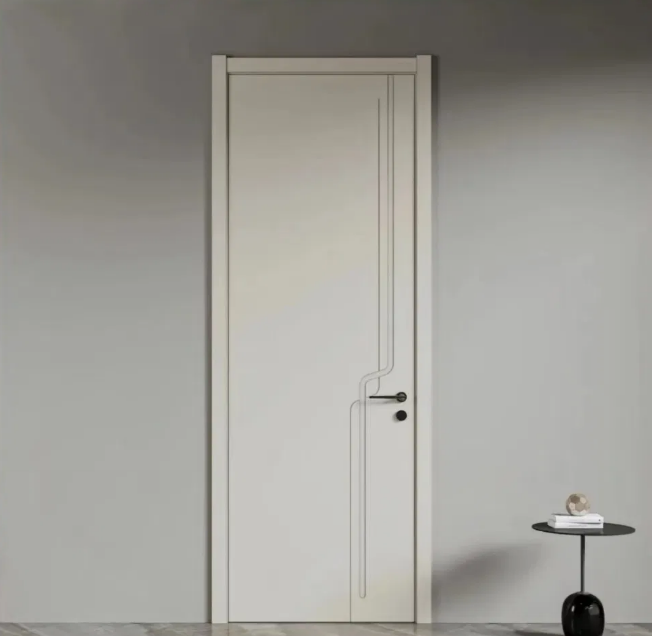
The HPL Laminated Interior door is a product of advanced material engineering, combining resin chemistry, heat compression technology, and structural wood composites.
HPL production begins with kraft paper sheets impregnated with phenolic resin, layered with decorative paper and melamine overlays. These layers are then compressed at high temperature and pressure to form a rigid sheet with a density exceeding 1.35 g/cm³.
After production, the laminate is bonded to a core material using industrial adhesives under hydraulic pressing systems.
Standard manufacturing parameters include:
Pressing temperature: 120–150°C
Pressure: 800–1,200 psi
Laminate thickness: 0.5–1.2 mm
Adhesive curing time: 20–40 minutes per panel cycle
Core material moisture content: 8–12%
The laminated surface provides:
Non-porous structure preventing liquid penetration
High mechanical strength against impact
Thermal resistance up to moderate indoor temperature variations
Stable color retention over long exposure periods
The HPL Laminated Interior Door structure typically consists of three layers:
Decorative HPL surface
Engineered wood core
Balancing back layer
This multi-layer composition ensures structural balance and prevents warping. The result is a door system that maintains performance stability under varying environmental conditions.

 Arabic
 French
 Spanish
 Portuguese
 Deutsch
 Turkish
 Dutch
Dutch
 Italiano
 Russian
 Romaian
 Portuguese (Brazil)
 Greek
Greek