
Understanding Slip and Load Behavior in Industrial Drives
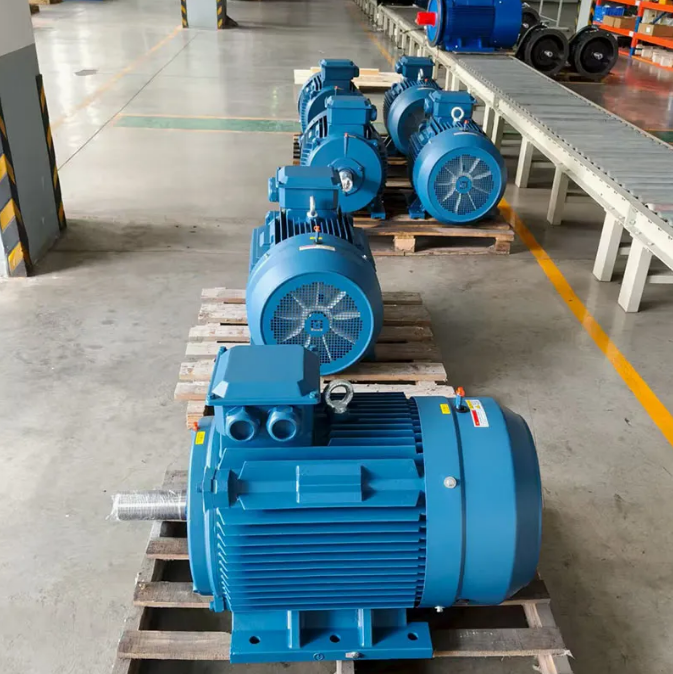
In many engineering discussions, Industrial Asynchronous Motors are often highlighted as practical solutions for real-world load conditions. Unlike theoretical models, actual industrial operation involves fluctuating torque demand, voltage variations, and thermal constraints.
A key operating parameter is slip, defined as the difference between synchronous speed and rotor speed. In typical industrial motors, slip values range from 2% to 5% at rated load. For a 1500 rpm synchronous speed motor, actual speed may be around 1440–1470 rpm depending on load.
Voltage tolerance is another critical factor. Industrial motors are designed to operate within ±10% of rated voltage. For example, a 400V motor can safely operate between approximately 360V and 440V, though efficiency and temperature rise may vary.
Current behavior under load is non-linear. At no-load conditions, current may be only 25%–40% of rated current, while at full load it reaches nominal values. Locked rotor current can be 6–7 times rated current, which is important for protection system design.
Thermal behavior is often a limiting factor in continuous operation. Winding temperature rise is typically limited to 80K–100K depending on insulation class. Proper ventilation and cooling (IC411, IC416 systems) help maintain safe operating conditions.
Engineers often pair asynchronous motors with frequency converters to improve dynamic response. Vector control methods allow better torque control at low speeds, reducing vibration and improving system stability.
In real applications, these motors are chosen not for theoretical perfection but for predictable behavior, mechanical simplicity, and tolerance to harsh environments.
 Italiano
 English
 Arabic
 French
 Spanish
 Portuguese
 Deutsch
 Turkish
 Dutch
Dutch
 Russian
 Romaian
 Portuguese (Brazil)
 Greek
Greek