
Nante Outdoor Electrical Distribution Panel: Durable Power Hubs
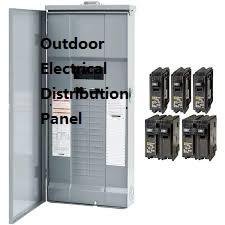
Every site that relies on distributed power needs deliberate equipment choices, and early specification of the Outdoor Electrical Distribution Panel in project documents helps avoid costly substitutions and field delays. Facility managers should also verify environmental class and accessory lists when the Outdoor Electrical Distribution Panel is first selected, because those early decisions determine enclosure, grounding, and surge protection strategies that affect long-term reliability.
Siting, footprint, and structural considerations
Choosing where the panel will live is as important as choosing the panel itself. Locate units to minimize long cable runs while keeping clearances for maintenance and emergency access. Consider foundations or mounting pads that reduce vibration and prevent flooding; even modest elevation above finished grade dramatically reduces moisture-related failures. Account for door swing, personnel access, and the routing of conduit or cable trays so that future expansions are straightforward. In retrofit scenarios, evaluate substrate strength and plan backing plates or reinforcement to avoid relying on thin cladding for mechanical support.
Enclosure, material selection, and corrosion protection
Outdoor panels face sunlight, precipitation, salt spray, and industrial contaminants, so the choice of enclosure material and surface treatment determines service life. Stainless steel grades and marine-grade coatings offer excellent resistance in coastal environments, while powder-coated aluminum balances weight and thermal performance for inland installations. Pay attention to gasket compounds — EPDM and silicone perform differently across temperature ranges and chemical exposures. Fasteners and internal mounting hardware should be corrosion resistant or isolated to prevent galvanic reactions that accelerate degradation.
Electrical design: distribution, protection, and redundancy
A practical panel layout groups circuits logically, provides adequate space for breakers and protective devices, and routes neutral and grounding conductors to minimize impedance under fault conditions. Specify protective devices with coordination in mind: upstream and downstream settings should limit fault currents while allowing selective isolation. Include surge protective devices (SPDs) sized for the service and environment, and plan for future growth by leaving provisioned spaces or bus extensions. When reliability is critical, design redundancy into the distribution scheme with automatic transfer switches or parallel feeders to minimize downtime during maintenance or failure.
Thermal management and cable termination practices
High currents and dense assemblies generate heat; thermal planning keeps internal temperatures within component limits and reduces failure risk. Use interior layout to separate heat-generating components from sensitive controls, and provide ventilation or filtered breather solutions where sealed operation would otherwise trap heat. For sealed panels, consider thermostatically controlled fans or heat exchangers that preserve ingress protection while enabling heat rejection. Proper cable termination — correct ferrules, torque-controlled terminals, and appropriately sized strain reliefs — prevents high-resistance joints that become thermal hotspots. Document torque values and initial contact resistance for future inspection comparisons.
Grounding, bonding, and lightning protection
Grounding is foundational to safety and electromagnetic compatibility. Bond enclosures, busbars, and service equipment with copper conductors sized per local code and the likely fault current. Establish single-point grounding schemes for control electronics when necessary to reduce stray currents and unwanted loops. In lightning-prone regions or for critical infrastructure, integrate lightning protection systems and coordinate SPDs with upstream grounding to ensure that transient energy is diverted safely. Document grounding paths and include test points to permit routine verification of low-impedance connections.
Commissioning, maintenance, and lifecycle economics
A panel’s lifecycle cost often dwarfs its purchase price, so invest in thorough commissioning and scheduled maintenance. Commissioning should include insulation resistance testing, phase rotation verification, protective device trip tests, and thermal imaging under load. Create a maintenance plan with interval-based inspections for seals, fasteners, contact resistance, and SPD health. Keep spare parts kits that include common breakers, gaskets, and terminal hardware to shorten downtime. Track maintenance events and ambient conditions to refine inspection frequency — harsh environments will require more frequent attention and part replacement.
Selecting an outdoor distribution panel is a systems decision: match electrical capacity and protection schemes to the load profile, choose materials that withstand the local climate, and plan for access, maintenance, and growth. Thoughtful engineering up front reduces operational surprises and keeps distributed power working reliably for years. For detailed specification examples and industry guidance on outdoor distribution panels, visit https://www.nante.com/news/industry-news/outdoor-electrical-distribution-panel-nante.html
 Dutch
Dutch
 English
 Arabic
 French
 Spanish
 Portuguese
 Deutsch
 Turkish
 Italiano
 Russian
 Romaian
 Portuguese (Brazil)
 Greek
Greek