
Can Real Time Measurement Improve Wire Tolerance Control?
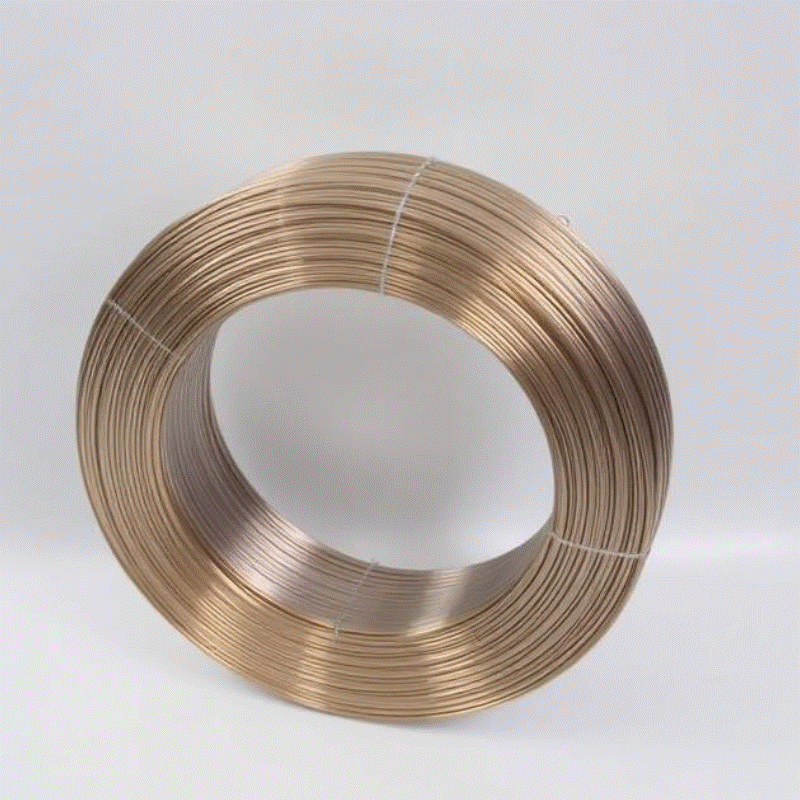
Dimensional precision in welding wire manufacturing directly impacts process stability and weld quality because diameter variations alter current density, heat input, and filler deposition rates in ways that disrupt carefully calibrated welding parameters. Engineers specifying materials for automated production systems understand that tight tolerances separate reliable manufacturing inputs from problematic consumables that generate scrap and downtime. Aluminum MIG Wire Manufacturers investing in precision manufacturing equipment and rigorous process controls deliver dimensional consistency that supports predictable welding outcomes, while commodity producers tolerating wider variations create materials that force constant parameter adjustments and compromise quality.
Drawing die design and maintenance form the foundation for diameter control because these precision tools determine the cross sectional dimensions wire achieves during manufacturing. High quality dies machined to exact specifications and replaced before excessive wear develops maintain consistent wire diameter throughout production runs. Worn dies create diameter drift as material removal rates change with accumulated usage, generating progressive size variations that appear as inconsistent welding behavior. Manufacturers monitoring die condition and implementing scheduled replacement based on production volume prevent the diameter creep that inadequate die maintenance allows.
Real time diameter measurement systems provide immediate feedback enabling process adjustments before significant quantities of out of tolerance material accumulate. Laser micrometers, air gauges, or contact measurement devices positioned inline during production detect diameter deviations as they occur, triggering automatic adjustments to drawing speeds, die temperatures, or take up tension that restore dimensions to target values. This closed loop control prevents the batch to batch variations that plague manufacturers lacking continuous monitoring capabilities, delivering consistent diameter from spool start to finish.
Temperature control throughout the drawing process affects wire dimensions because thermal expansion and contraction alter material properties and die clearances during production. Maintaining stable temperatures in drawing dies, cooling systems, and ambient production environments eliminates dimensional variations from thermal cycling. Manufacturers in climate controlled facilities with temperature regulated dies achieve tighter tolerances than those operating in environments where daily and seasonal temperature swings create dimensional drift requiring constant parameter readjustment.
Take up tension and speed coordination determine how drawn wire winds onto spools without introducing diameter variations from stretching or compression during handling. Precise tension control maintains consistent wire stress throughout winding, preventing the diameter changes that excessive or insufficient tension creates. Synchronized speed matching between drawing and take up operations eliminates the pulling or bunching that dimensional consistency demands avoiding throughout production sequences.
Surface finish interactions with diameter measurement create apparent tolerance variations when surface irregularities or residues interfere with measurement accuracy. Wire with inconsistent surface texture may measure differently at various points along its length despite actual diameter remaining constant, creating false tolerance failures. Manufacturers employing effective cleaning and surface preparation before final measurement eliminate these artifacts, providing accurate diameter data supporting legitimate tolerance claims.
Quality control sampling frequency determines how quickly manufacturers detect and correct diameter deviations that production variations inevitably create. Continuous inline measurement provides real time detection, while periodic sampling at intervals introduces delay between deviation onset and corrective action. This delay allows varying quantities of out of tolerance material to accumulate before detection, making sampling frequency a critical tolerance control factor.
Statistical process control techniques applied to diameter measurement data enable proactive process adjustments before tolerances are exceeded. Tracking diameter trends over time reveals gradual drift patterns that predict when tolerances will breach, allowing preventive adjustments maintaining continuous conformance. Manufacturers analyzing their diameter data statistically achieve tighter effective tolerances than those simply measuring and accepting anything within specification limits.
Material properties including aluminum alloy composition, temper condition, and grain structure affect how readily wire achieves and maintains dimensional targets during drawing operations. Some aluminum alloys draw more uniformly than others, making tight tolerances easier to achieve with certain compositions. Manufacturers understanding these material characteristic differences adjust their processes appropriately for each alloy type, maintaining consistent tolerances across their product range.
Packaging and handling protect wire dimensions during storage and transportation because mechanical damage from rough handling, improper stacking, or inadequate packaging deforms wire and disrupts carefully maintained manufacturing tolerances. Protective packaging, careful handling protocols, and appropriate shipping methods preserve the dimensional precision manufacturing controls establish, ensuring wire reaches end users in the condition quality systems verified.
Customer requirements drive tolerance specifications because automated welding systems demand tighter tolerances than manual processes can accommodate through operator adjustment. Robotic and mechanized welding operations programmed around specific wire dimensions cannot compensate for dimensional variations that manual welders unconsciously adjust for through technique modification. Understanding application requirements helps manufacturers establish appropriate tolerance targets balancing manufacturing capability against customer needs.
Certification documentation demonstrating actual measured tolerance performance validates manufacturer claims and provides assurance that purchased materials meet dimensional requirements. Detailed measurement data showing actual diameter ranges achieved rather than simply claiming conformance to specifications enables customers to verify tolerance capability before committing to large purchases.
The manufacturing investments in precision equipment, process controls, and quality systems necessary for achieving tight diameter tolerances explain why premium priced wire from quality focused manufacturers delivers value through reduced welding problems compared to commodity alternatives. Comprehensive tolerance information and precision manufactured aluminum MIG wire are available at https://kunliwelding.psce.pw/8p6qbl supporting automated welding operations requiring dimensional consistency.
 Deutsch
 English
 Arabic
 French
 Spanish
 Portuguese
 Turkish
 Dutch
Dutch
 Italiano
 Russian
 Romaian
 Portuguese (Brazil)
 Greek
Greek