
Understanding Metallic Yarn Structures in Knit Fabrics
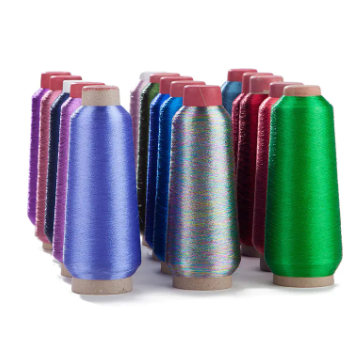
Knitted textiles achieve their appearance and elasticity through looped yarn structures, and yarn selection plays a major role in fabric behavior. Decorative textile producers increasingly use reflective yarn systems to create fabrics with dynamic visual effects. Among these materials, Metallic Yarn for Knitting has become widely discussed because it combines decorative shine with compatibility across multiple knitting technologies.
Metallic yarn is generally produced by laminating or coating thin polyester films with metallic layers before slitting them into narrow strips. These strips are then wrapped around support yarns such as nylon or polyester filament to improve flexibility during knitting. Some constructions also include acetate or viscose components depending on desired softness and drape.
Typical metallic yarn specifications include:
Film thickness: 12μm to 25μm
Yarn count: 20D to 150D
Metallic film width: 0.23mm to 0.37mm
Common colors: silver, gold, rainbow, holographic, and matte metallic finishes
The reflective performance of metallic yarn depends heavily on yarn surface geometry. Knitted loop structures create changing reflection angles as fabric stretches and moves. Research related to knitted fabric mechanics indicates that yarn arrangement and loop topology strongly influence overall fabric behavior including elasticity, dimensional recovery, and curl formation.
Manufacturers frequently combine metallic yarn with other textile fibers to balance aesthetics and processing stability. Acrylic blends may improve softness, while nylon support yarns can improve tensile performance during high-speed knitting. Cotton blends are commonly selected for breathable decorative knitwear applications.
Another technical consideration involves machine compatibility. Circular knitting machines can efficiently produce lightweight metallic jersey fabrics, while computerized flat knitting machines allow localized metallic pattern control. Warp knitting equipment is sometimes used for decorative mesh structures and stretch fabrics.
Surface finishing also influences final appearance. Brushed finishing may reduce direct reflection and create softer visual texture, while compact finishing can increase brightness by flattening yarn surfaces. Some textile producers apply anti-tarnish coatings to improve long-term color stability under storage and repeated washing conditions.
Reflective knitted fabrics are widely used in fashion apparel, stage costumes, accessories, and interior decoration textiles. Recent textile development also explores conductive and smart textile applications where metallic yarn contributes both decorative and functional properties.
As textile technology develops further, manufacturers continue refining metallic yarn softness, flexibility, and durability. Improved coating methods and advanced knitting systems are expanding the practical use of metallic knitted fabrics across both fashion and technical textile industries.
 Spanish
 English
 Arabic
 French
 Portuguese
 Deutsch
 Turkish
 Dutch
Dutch
 Italiano
 Russian
 Romaian
 Portuguese (Brazil)
 Greek
Greek