
Why Brass and Steel Work Together in Padlocks
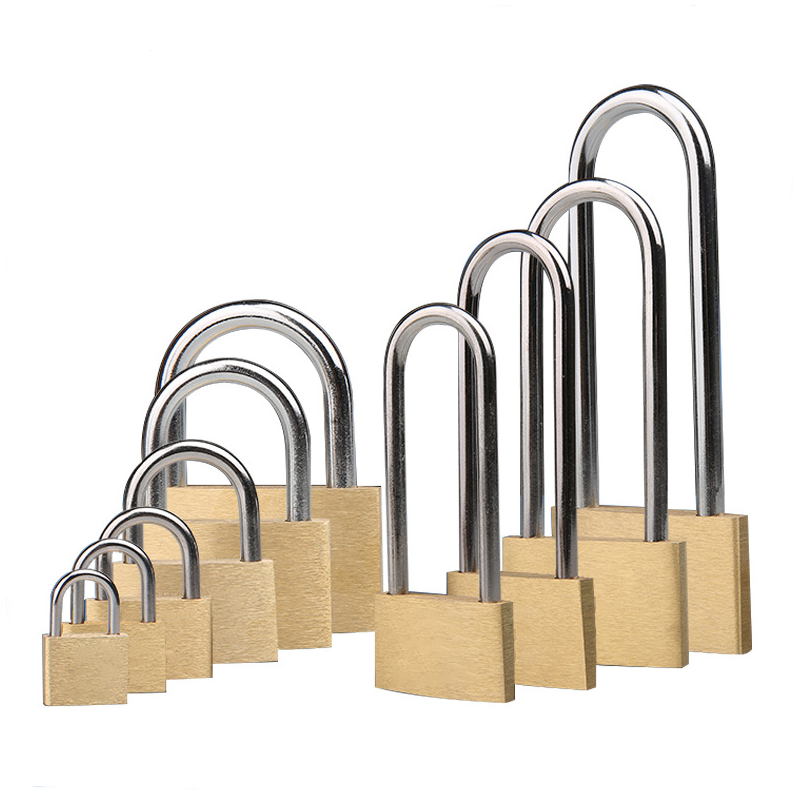
The performance of a long shackle Brass padlock depends heavily on material selection. Each component is engineered for a specific function, balancing corrosion resistance, mechanical strength, and manufacturability.
The body of the lock is typically made from brass due to its favorable properties:
High corrosion resistance
Excellent machinability
Stable performance in humidity
Low friction for internal components
Brass also protects internal pin tumbler components from environmental degradation. Since padlocks often operate outdoors, moisture resistance is critical for long-term reliability.
The shackle, however, is usually made from hardened steel. Steel provides significantly higher tensile strength and resistance to cutting tools. Through heat treatment processes such as quenching and tempering, the shackle gains increased hardness while maintaining structural toughness.
In long shackle designs, material engineering becomes even more important because:
Longer shackles increase leverage potential
More surface area is exposed
Stress distribution varies along the shackle length
To compensate, manufacturers often increase shackle diameter or apply protective coatings such as nickel plating.
A typical configuration includes:
Brass body for corrosion resistance
Hardened steel shackle for strength
Double-locking mechanism for stability
Protective keyway sealing in outdoor models
From a mechanical perspective, the extended shackle acts as a cantilevered structure when under force. This means stress concentration can occur near the locking points. Engineering design therefore focuses on reinforcing these areas.
In real-world usage, environmental resistance often matters as much as physical strength. Brass performs well in:
Humid climates
Coastal salt exposure
Temperature fluctuation environments
This makes the combination of brass and steel one of the most balanced designs in padlock engineering.
The long shackle Brass padlock is therefore a product of material optimization rather than simple design extension. Each component is selected to address a specific failure mode.
 Italiano
 English
 Arabic
 French
 Spanish
 Portuguese
 Deutsch
 Turkish
 Dutch
Dutch
 Russian
 Romaian
 Portuguese (Brazil)
 Greek
Greek