
How to Maintain an Extrusion Line?
Stable operation of rubber processing systems depends heavily on routine maintenance, parameter monitoring, and early detection of mechanical or thermal irregularities. Even small deviations in system performance can lead to dimensional instability or surface defects in final products.
Screw and barrel wear is a common long-term issue. Continuous friction between filled compounds and metal surfaces gradually reduces screw efficiency. Wear rates depend on filler content such as carbon black or silica. Barrel hardness is typically maintained above HRC 58–62 to reduce abrasion. Clearance increases beyond 0.5 mm can significantly affect output consistency.
Heating system instability is another frequent problem. Barrel heaters operate within multiple zones, often controlled by thermocouples with ±1°C accuracy. Faulty sensors may lead to uneven heating, resulting in premature curing or under-plasticized material. Heater band lifespan typically ranges from 6,000 to 12,000 operating hours depending on load conditions.
Cooling system blockages can reduce heat exchange efficiency. Water-cooled systems require filtration levels below 100 microns to prevent scaling. Flow rates usually range from 5 to 30 L/min depending on extruder size. Reduced cooling efficiency may cause deformation or shrinkage in profiles.
Die blockage or contamination often results from compound impurities or insufficient filtration. Regular die cleaning cycles help maintain stable flow channels. Pressure fluctuations exceeding 10% are often indicators of partial obstruction.
Puller misalignment affects dimensional accuracy. Belt or roller systems must maintain synchronized traction to prevent stretching or compression. Force imbalance can lead to cross-sectional distortion, especially in soft rubber compounds.
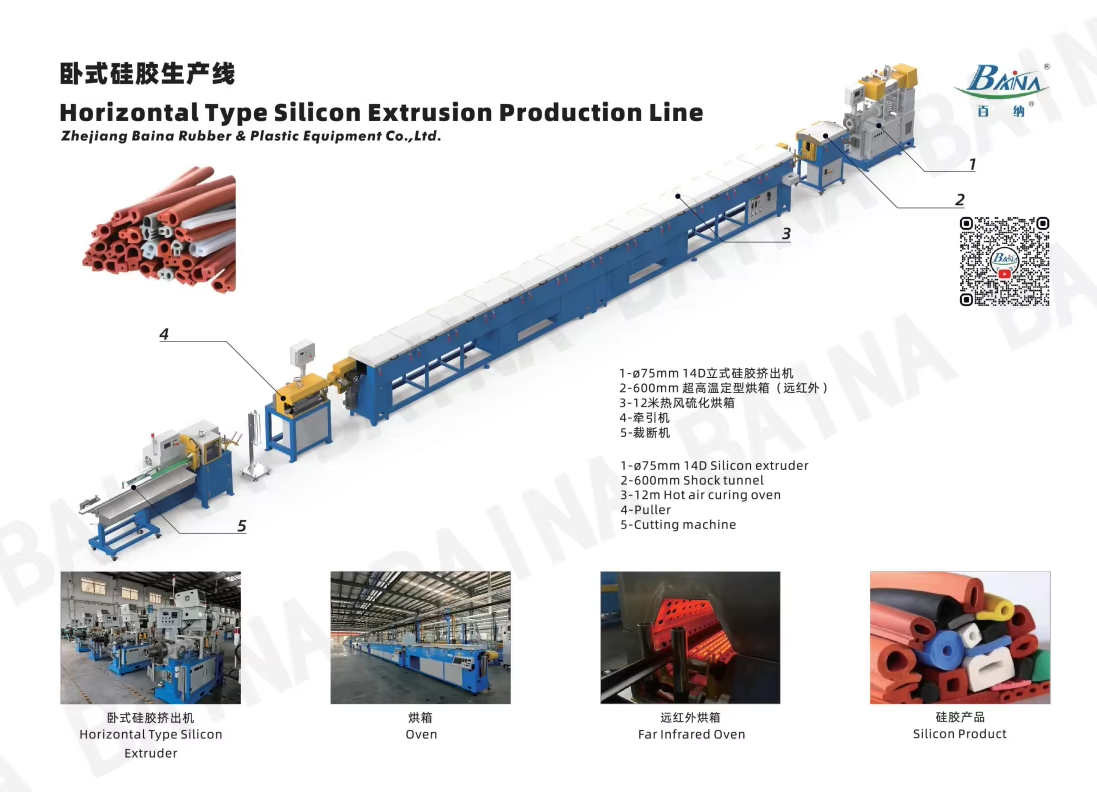
A rubber extrusion production line requires coordinated monitoring across all subsystems. PLC systems often include alarms for pressure spikes, temperature deviation, and motor overload conditions.
Lubrication systems also play a critical role. Bearings and gearbox assemblies require periodic lubrication with viscosity grades typically between ISO VG 150 and VG 320. Insufficient lubrication may result in vibration and reduced mechanical efficiency.
Preventive maintenance schedules often include daily inspection of temperature readings, weekly cleaning of feed zones, and monthly calibration of measurement systems. Laser gauges and infrared sensors assist in early detection of dimensional drift.
Proper maintenance extends equipment lifespan and stabilizes output quality. Consistent monitoring reduces downtime and supports continuous industrial production.
 Romaian
 English
 Arabic
 French
 Spanish
 Portuguese
 Deutsch
 Turkish
 Dutch
Dutch
 Italiano
 Russian
 Portuguese (Brazil)
 Greek
Greek