
How Does a Linear Guide CNC Machine Support Automation Systems?
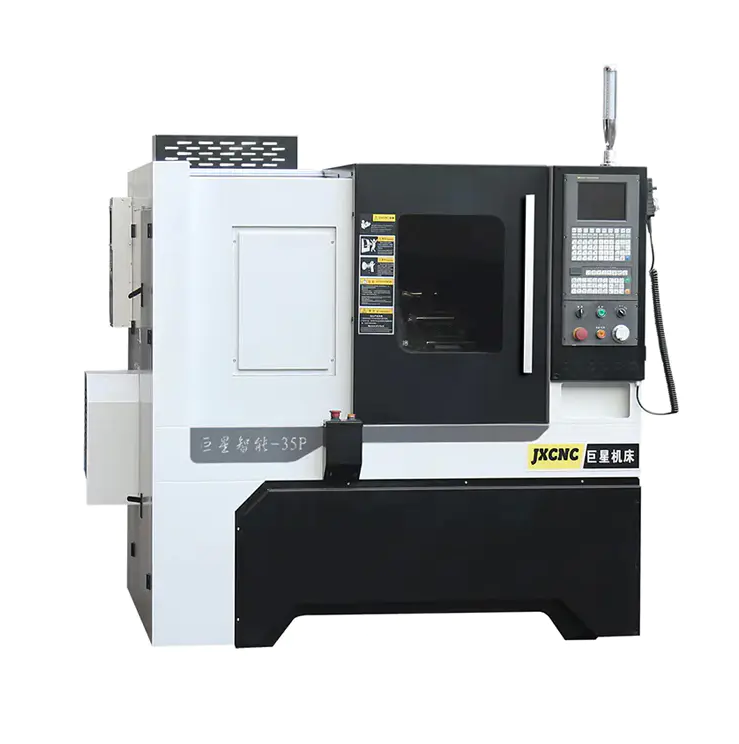
Modern manufacturing systems are increasingly adopting automation and digital integration. A Linear Guide CNC Machine is well-suited for this environment due to its stable motion system, predictable accuracy, and compatibility with robotic handling equipment.
Automation requires machines that can operate continuously with minimal deviation in positioning and cycle time.
Motion Stability for Automated Production
In automated manufacturing lines, repeatability is more important than manual adjustment flexibility.
A Linear Guide CNC Machine supports automation through:
High repeat positioning accuracy (±0.003–0.005 mm)
Stable axis motion under continuous load
Reduced friction for consistent servo response
Rigid machine structure for long-cycle stability
Guide systems typically include:
Four-row ball circulation blocks
Hardened steel linear rails
Precision ground mounting surfaces
Preloaded carriage systems
These features ensure stable performance in unattended production environments.
Integration with Robotic Loading Systems
Robotic arms are widely used for loading and unloading workpieces.
Integration features include:
Automatic door systems
Robot interface communication ports
Pallet changing systems
Fixture positioning accuracy alignment
Common robotic functions:
Raw material loading
Finished part unloading
Intermediate inspection transfer
Continuous production cycle handling
This reduces manual labor requirements and increases production continuity.
CNC Control and Smart Communication
Automation requires advanced control system communication.
A Linear Guide CNC Machine may support:
Ethernet-based industrial communication
PLC integration
MES system connectivity
Remote monitoring and diagnostics
Tool life tracking systems
Programming functions include:
Multi-program scheduling
Automatic tool compensation
Real-time load monitoring
Alarm prediction systems
These capabilities support smart factory operations.
Structural Design for Continuous Operation
Machines used in automation must operate for long durations.
Key structural elements include:
Heavy-duty cast iron base
Thermal symmetry design
Reinforced column structure
High-rigidity saddle assembly
Ball screw systems are often:
Preloaded to reduce backlash
Supported at both ends
Lubricated through automatic systems
This ensures consistent motion over extended production periods.
Tool Management in Automated Environments
Tool change systems are critical in automation.
Typical configurations:
16 to 30 tool magazine capacity
Arm-type or disc-type ATC systems
Tool change time: 2–5 seconds
Tool length and weight compensation systems
This supports multi-operation machining without manual intervention.
Production Monitoring and Data Feedback
Smart factories require data-driven production control.
A Linear Guide CNC Machine may collect:
Spindle load data
Axis movement tracking
Tool wear conditions
Temperature monitoring
Cycle time statistics
This data can be used for predictive maintenance and process optimization.
Industrial Application in Automation Lines
Automated CNC systems are used in:
Automotive mass production
Electronics manufacturing
Precision parts machining
Aerospace component production
Industrial equipment fabrication
These industries rely on stable cycle times and continuous operation.
Conclusion
A Linear Guide CNC Machine provides stable motion, precise repeatability, and strong compatibility with automation systems. Its design supports robotic integration, smart monitoring, and continuous production workflows. As manufacturing shifts toward intelligent factories, this type of machine structure plays an important role in maintaining efficiency and consistency across automated machining environments.
 Dutch
Dutch
 English
 Arabic
 French
 Spanish
 Portuguese
 Deutsch
 Turkish
 Italiano
 Russian
 Romaian
 Portuguese (Brazil)
 Greek
Greek