
How AI Application Development Services Drive Competitive Business Advantage
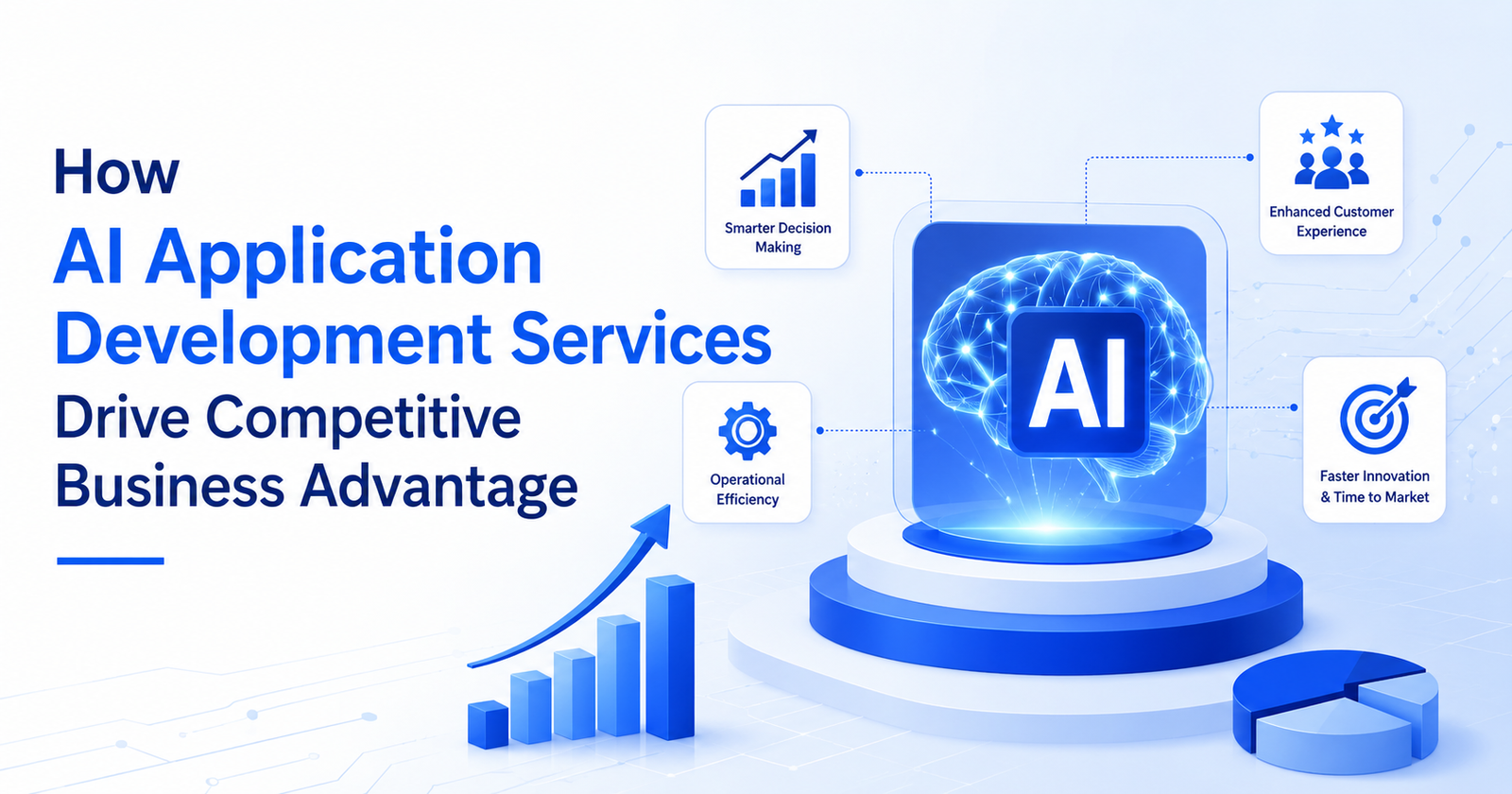
Competitive advantage used to be about who had the better product, the better price, or the better marketing budget. Increasingly, it's about who built the smarter app. Two companies can sell nearly identical products today, charge similar prices, and run comparable ad campaigns, yet one pulls ahead simply because its mobile experience anticipates what customers want before they ask for it, while the other still makes users dig through five menus to do something simple. That gap, subtle as it sounds, is where market share actually changes hands now, and it's why AI application development services have quietly become one of the most consequential investments a business owner can make this year.
What's easy to miss is that this advantage compounds. An app that learns from user behavior gets sharper every month it's in use, while a static app stays exactly as good as the day it launched, slowly falling further behind as customer expectations rise around it. Businesses that understood this early are now sitting on a lead that's getting harder for competitors to close.
The Widening Gap Between Smart Apps and Static Apps
A static app is a fixed set of screens and features, built once and updated occasionally when something breaks or a competitor forces a feature parity update. A smart app, by contrast, adjusts itself — recommending products based on actual browsing patterns rather than generic bestseller lists, predicting when a customer is about to churn and triggering a retention action automatically, or surfacing the exact piece of information a user needs based on their specific history with the business. The difference isn't cosmetic; it shows up directly in conversion rates, retention numbers, and customer lifetime value.
Business owners who've run both versions side by side, even informally through A/B testing, often find the gap larger than they expected going in. Customers don't necessarily notice the AI working in the background, but they absolutely notice when an experience feels effortless versus when it feels like work, and that perception drives loyalty whether or not the customer can articulate why.
- Personalized recommendations driving measurably higher conversion rates
- Predictive churn signals that allow proactive retention instead of reactive damage control
- Smarter search and discovery that reduces frustration-driven app abandonment
- Continuous improvement loops that make the app better the longer it's used
This is the foundational case for treating intelligent functionality as a core part of any app investment rather than a future upgrade to consider once the budget allows.
What Separates a Capable Development Partner From a Risky Bet
Plenty of agencies will claim AI capability today because the term sells well in a pitch deck, but actually delivering reliable, production-grade intelligent features requires a different depth of experience than building a standard app. A genuinely capable AI application development company brings engineers who understand model selection, data pipeline design, and the unglamorous but critical work of testing AI behavior against edge cases before it ever reaches a real customer. The businesses that get burned in this space usually hired based on a confident sales pitch rather than evidence of prior, similar work actually shipped and performing well.
Vetting properly means asking for specifics rather than accepting vague reassurances. How did they handle a past project where the model's predictions were initially inaccurate? What's their process for retraining as user data accumulates? How do they prevent a recommendation engine from reinforcing bias or pushing customers toward options that don't actually serve them well?
- Demonstrated experience with model integration, not just app development generally
- Clear processes for testing AI behavior against unusual or edge-case scenarios
- Transparent communication about limitations rather than overselling capability
- Willingness to start with a smaller pilot feature before a full rollout commitment
A short paid pilot project is often the smartest way to evaluate a potential partner honestly before committing a full app development budget to them.
What a Genuinely Complete AI Build Should Include
Once a strong partner is in place, it helps to understand the full scope of what a serious engagement should cover, because narrow engagements tend to produce narrow, underwhelming results. Comprehensive AI application development services go well beyond bolting a chatbot onto an existing app — they include data infrastructure work to ensure the AI features have clean, reliable information to learn from, careful UX design so intelligent features feel helpful rather than intrusive, and rigorous monitoring after launch to catch drift or degraded performance before customers notice it first.
Skipping any of these stages tends to produce the kind of AI feature that works fine in a demo and then quietly underperforms in production, eroding trust in the technology even though the underlying concept was sound. Business owners reviewing a proposal should look specifically for these components rather than assuming they're automatically included.
- Data pipeline and infrastructure work to support reliable AI performance
- Thoughtful UX integration so intelligent features feel natural, not forced
- Ongoing monitoring and retraining cycles after the initial launch
- Clear metrics defined upfront to measure whether the feature is actually working
This is the stage where the gap between an impressive demo and a genuinely valuable production feature gets decided, and it deserves more scrutiny than most business owners give it.
Why Mobile Remains the Primary Battlefield for This Advantage
Despite years of predictions that some other channel would dethrone it, mobile remains where most customer relationships actually live — it's where people check prices, compare options, make purchases, and decide whether a brand feels modern or dated. This is exactly why Mobile App Development Services sit at the center of any serious competitive strategy rather than being treated as one channel among many. An app is the one digital surface a business fully controls, unlike a social platform algorithm or a marketplace listing that can change its rules overnight.
Investing seriously here means treating the mobile app as a strategic asset rather than a checkbox item next to the website. Businesses that understand this tend to allocate real budget toward continuous app improvement rather than a one-time build followed by years of neglect, and the compounding advantage from that ongoing investment shows up clearly in retention and customer satisfaction metrics over time.
- Full ownership of the customer experience without third-party platform dependency
- Direct channel for push notifications, loyalty programs, and personalized engagement
- Continuous investment opportunities that compound advantage over static competitors
- Data collection that fuels the very AI features driving further differentiation
Mobile isn't just one piece of a digital strategy anymore — for most consumer-facing businesses, it's increasingly the entire relationship.
Capturing the Android Market Without Losing Quality
Android's global reach makes it impossible to ignore for any business with ambitions beyond a single affluent market segment, but its device fragmentation creates real engineering challenges that a careless partner can get badly wrong. Strong Android App Development Services require deliberate testing across a wide range of screen sizes, processing capabilities, and OS versions, since a feature that runs beautifully on a flagship device might stutter badly on the mid-range phones that represent the bulk of users in many fast-growing markets. Businesses targeting price-sensitive or emerging markets in particular need to take this seriously rather than testing exclusively on premium devices and assuming the results will hold everywhere.
Getting this right opens access to enormous user bases across regions where Android dominates market share by a wide margin, making it a critical piece of any genuinely global growth strategy rather than a secondary consideration behind iOS.
- Rigorous testing across diverse device specifications and OS versions
- Careful performance optimization for mid-range and lower-spec devices
- Strategic importance in markets where Android holds dominant market share
- Compatibility planning that anticipates fragmentation rather than reacting to it later
Ignoring this complexity, or assuming a single testing pass on one device is sufficient, is one of the more common and costly mistakes business owners make when scaling into broader markets.
Earning Premium Trust Through a Polished iOS Experience
While Android wins on reach, iOS users in many markets represent a disproportionately valuable customer segment in terms of spending behavior and brand loyalty expectations. Quality iOS App Development Services matter precisely because Apple's user base holds apps to a noticeably higher bar for polish, responsiveness, and design consistency — cutting corners here tends to show up quickly in reviews and retention numbers in a way it might not on a more forgiving platform. Apple's stricter review and design guidelines also mean a development partner genuinely needs platform-specific expertise rather than treating it as an afterthought tacked onto an Android-first build.
Businesses that invest properly in this experience often find it pays back disproportionately, since iOS users frequently drive outsized revenue relative to their share of total users, particularly in subscription-based, premium, or luxury-positioned products.
- Strict adherence to Apple's design and review guidelines to avoid rejection delays
- Attention to interface polish that meets the platform's higher quality expectations
- Strong fit for subscription and premium business models with loyal user bases
- Platform-specific performance tuning rather than a generic cross-platform approach
Treating iOS as equally important rather than secondary, even in markets where Android holds more total users, often determines whether a business captures its most valuable customer segment effectively.
Turning All of This Into a Lasting Advantage
None of these pieces — intelligent features, the right development partner, mobile strategy, and platform-specific execution — deliver much value in isolation. The real competitive advantage emerges when they're combined deliberately: an app that's smart, fast, polished on both major platforms, and continuously improved rather than left to stagnate after launch. Business owners who treat this as an ongoing strategic investment, not a one-time project with a finish line, are the ones building a lead that becomes genuinely difficult for competitors to catch.
The market is moving toward intelligent, platform-thoughtful mobile experiences whether any individual business chooses to invest or not. The only real choice left is whether to lead that shift within your industry or spend the next several years trying to catch up to whoever did.
 Dutch
Dutch
 English
 Arabic
 French
 Spanish
 Portuguese
 Deutsch
 Turkish
 Italiano
 Russian
 Romaian
 Portuguese (Brazil)
 Greek
Greek